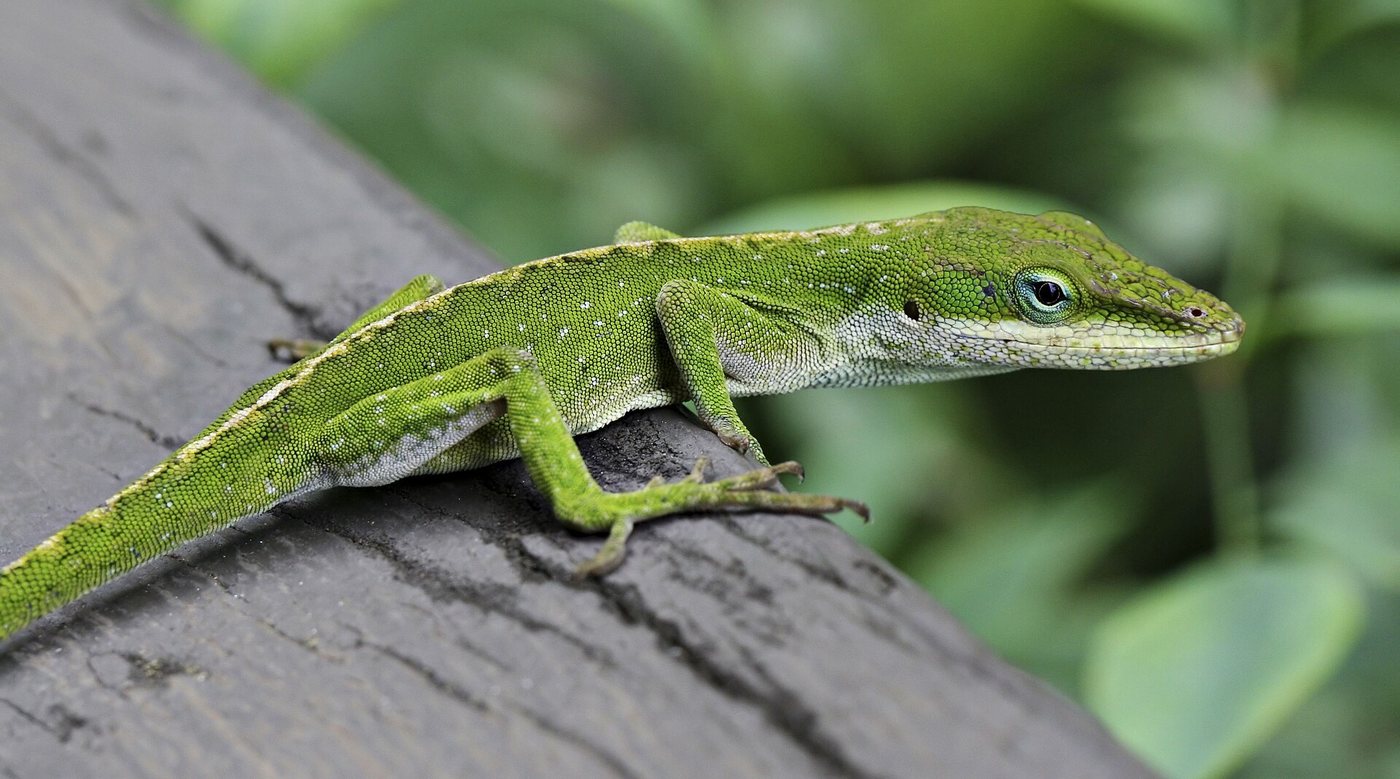
Overview
The green anole is the little lizard on a million American fence posts: an emerald, big-eyed climber that puffs out a pink throat fan, does push-ups at rivals, and can shift colour from green to brown with mood and temperature. In a planted terrarium it does all of this in miniature, hunting fruit flies and duelling with its own reflection. It is cheap, small, and charming — and honest sellers will add: fragile, fast, and a pet for watching rather than holding.
Temperament & personality
Anoles are all theatre. Males spend the day displaying — dewlap (throat fan) flares, head-bobs, and push-ups aimed at rivals, females, and keepers alike. They are quick, nervous lizards that experience handling as a predator attack, and stressed anoles turn brown and hide. Kept singly or as one male with females (never two males — they fight), in a leafy vertical terrarium, they are lively, bold at feeding time, and completely absorbing to observe.
Appearance
A slim, long-toed climber with a pointed snout and adhesive toe pads. Males are larger, with a bigger head and the famous extensible throat fan — pink to reddish in this species. The base colour flips between vivid green and chocolate brown depending on temperature, light, and stress; it is mood and camouflage, not a party trick on command. Females and juveniles often carry a pale stripe down the spine.
Care & daily life
Think of a green anole terrarium as a slice of vertical garden: a tall enclosure (18×18×24 in minimum) packed with live or silk plants, thin branches, and a cork background for climbing. Provide a basking spot of 85–90°F, a gradient down to the mid-70s, and a proper UVB light — anoles are day-active sunbathers and develop metabolic bone disease without it. Mist daily to hold humidity at 60–70% and provide drinking droplets; most anoles lick water from leaves rather than using a bowl, though a small dish is still worth offering. Feed small live insects daily or every other day — pinhead-to-small crickets, fruit flies, tiny roaches — dusted with calcium and vitamins. Males must never be housed together.
Health & lifespan
The Green Anole is generally known for the following health watch-points:
- Metabolic bone disease from missing UVB or calcium — soft jaw, tremors, kinked spine
- Dehydration and stuck shed when humidity and misting fall short
- Stress decline in males housed together or in barren, exposed enclosures
- Mouth rot and skin infections in dirty or overly damp setups
- Internal parasites, common in wild-caught animals (many pet anoles are still wild-caught)
Living with a Green Anole
Green anoles suit keepers who enjoy a living terrarium and natural behaviour over handling — students, plant people, and anyone with room for a modest planted tank. The arithmetic to respect: they are inexpensive to buy but need UVB, misting, and live food daily, and a lifespan of up to eight years. They are a poor choice for children who want to hold their pet, and wild-caught stock raises both welfare and parasite concerns — buy captive-bred where possible.
History
Anolis carolinensis is native to the southeastern United States, from North Carolina to Texas, and has been introduced to Hawaii, parts of California, and beyond. It is the only anole native to the mainland US and one of the most studied lizards on Earth — its genome was the first reptile genome sequenced, and its push-up displays are a textbook of animal communication. In Florida it now competes with the introduced brown anole, a living lesson in invasive species.