Overview
The neon tetra is the most recognisable aquarium fish on earth: a centimetre of electric blue and red that, multiplied by twenty, becomes the reason planted tanks exist. It is also a fish with two reputations — beginner staple and delicate diva — and both are artefacts of timing. Added to a mature, stable tank in a proper group, neons are hardy, long-lived schoolers; added to a fresh tank in a trio, they perish and take their reputation with them.
Temperament & personality
Neons are flock animals with flock psychology: safety, confidence, and colour all scale with numbers. In a proper school they drift and flash as one organism, loose and unhurried; in a pair they hug the plants and fade. Individual personality barely registers — the school is the personality — and their peacefulness is total, which makes them everyone else's lunch when tankmates are chosen carelessly.
Appearance
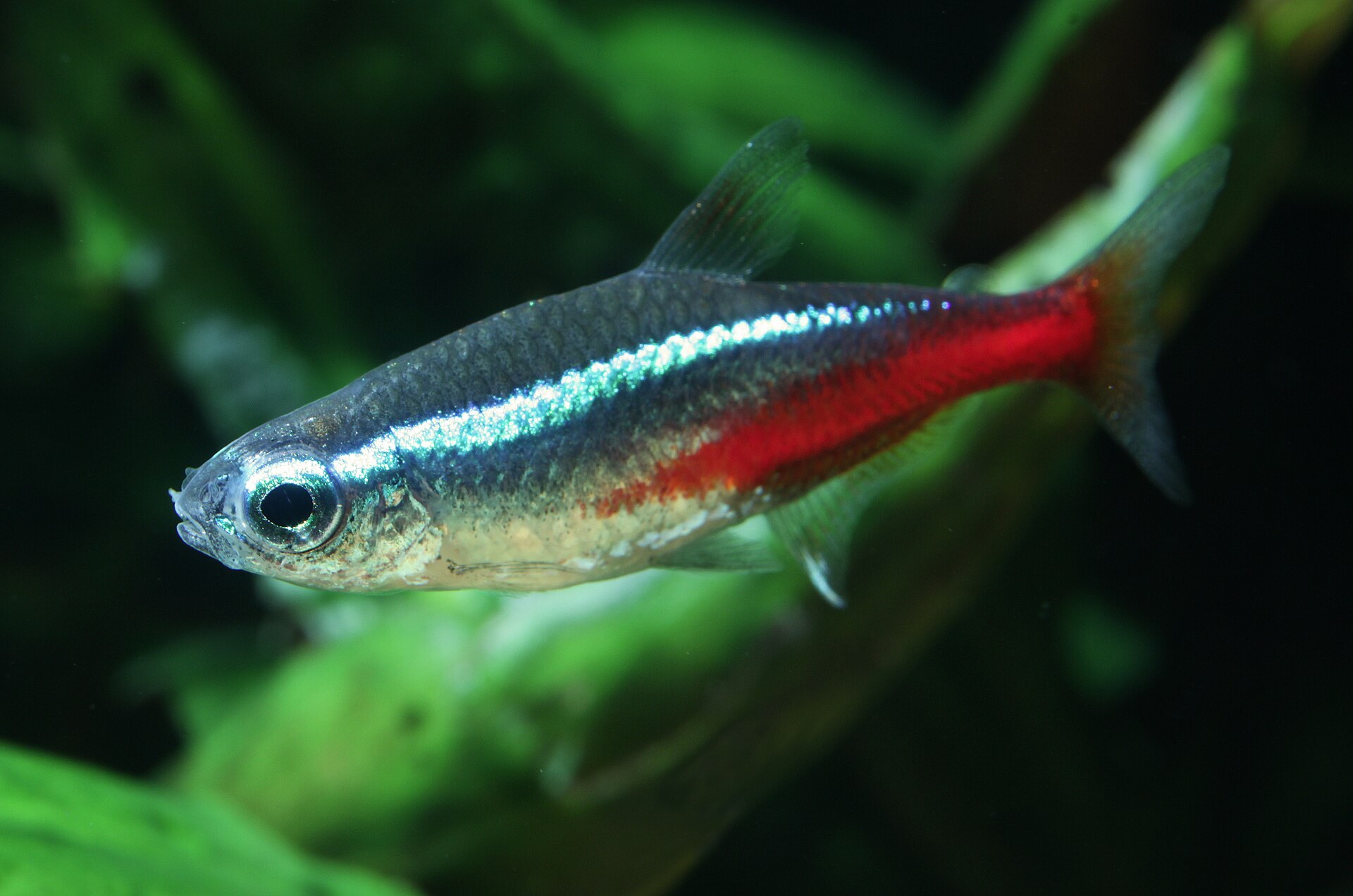
A silver sliver lit from within: the neon's upper half glows with an iridescent blue-green stripe from nose to tail, while the rear lower half burns signal red. The colours are structural and pigment-based beacons evolved for shady blackwater — in a dim, planted tank a school shifts light like a string of moving LEDs. Cardinal tetras, their close cousins, carry the red the full length of the body; neons wear it only behind the midline, which is the quickest way to tell the two apart. Females are slightly plumper, bending the blue stripe.
Care & daily life
Stability is the entire neon tetra brief: a mature, cycled tank with soft, slightly acidic, warm water (72–76°F), low nitrate, and no sudden chemistry swings. Add neons to tanks that have been running for some weeks, acclimate slowly, and keep the group at ten or more in a 20-gallon-long if you possibly can — the display and the fishes' confidence both transform. Feed tiny foods: crushed flake, micro-pellets, daphnia, and baby brine shrimp sized to very small mouths. Dim or dappled lighting over a dark substrate shows their colour at its best, and dense planting gives the school its security.
Health & lifespan
The Neon Tetra is generally known for the following health watch-points:
- Neon tetra disease (Pleistophora) — a parasitic infection causing faded patches, restlessness, and curved spines; no reliable cure, which makes quarantine and removing sick fish the management
- Ich and other parasites, especially after shipping stress
- Sensitivity to ammonia and nitrite spikes in new tanks — the classic mass die-off scenario
- Columnaris, sometimes mistaken for neon tetra disease ('false NTD') and, unlike it, treatable
Living with a Neon Tetra
Neons suit calm community tanks, planted aquascapes, and keepers who value a moving picture over individual pet interactions. They are the right fish once a tank is stable and the wrong fish to cycle one. Their tiny size means tankmate math is done from the predator's perspective: anything that can fit a neon in its mouth — including a grown angelfish, their natural Amazonian companion in the wild and their executioner in a tank — eventually will.
History
Neon tetras come from the blackwater tributaries of the Amazon in Brazil, Peru, and Colombia, where tannin-stained, tea-coloured water made their glowing stripe a contact signal in the gloom. They exploded into the hobby in the 1930s–50s — the species name honours aquarist William T. Innes — and for decades every neon was wild-caught; today they are mass-bred in Asia and Florida, though wild Amazonian collection continues as a sustainable local fishery in some regions.