Overview
Every hobby has a summit species, and in freshwater it is the discus: a plate-sized, mandala-coloured cichlid whose keepers speak of it the way others speak of racehorses. The fish itself is peaceful, shy, and eminently keepable — the legend comes from its water. Discus evolved in some of the warmest, softest, cleanest water on earth and simply decline, slowly and then quickly, when asked to live in anything else. Master the water and the king is yours; the water is non-negotiable.
Temperament & personality
Discus are courtly fish: a group arranges itself in a loose hierarchy, greets its keeper at the glass, and conducts its disputes in slow-motion displays of fin and colour. They startle easily — a shadow, a slammed door — and take time to forgive changes. Individuals become recognisable, and long-term keepers describe favourites without embarrassment. Watch a settled group at dusk, fins spread and colours lit, and the 'king of the aquarium' title stops sounding like marketing.
Appearance
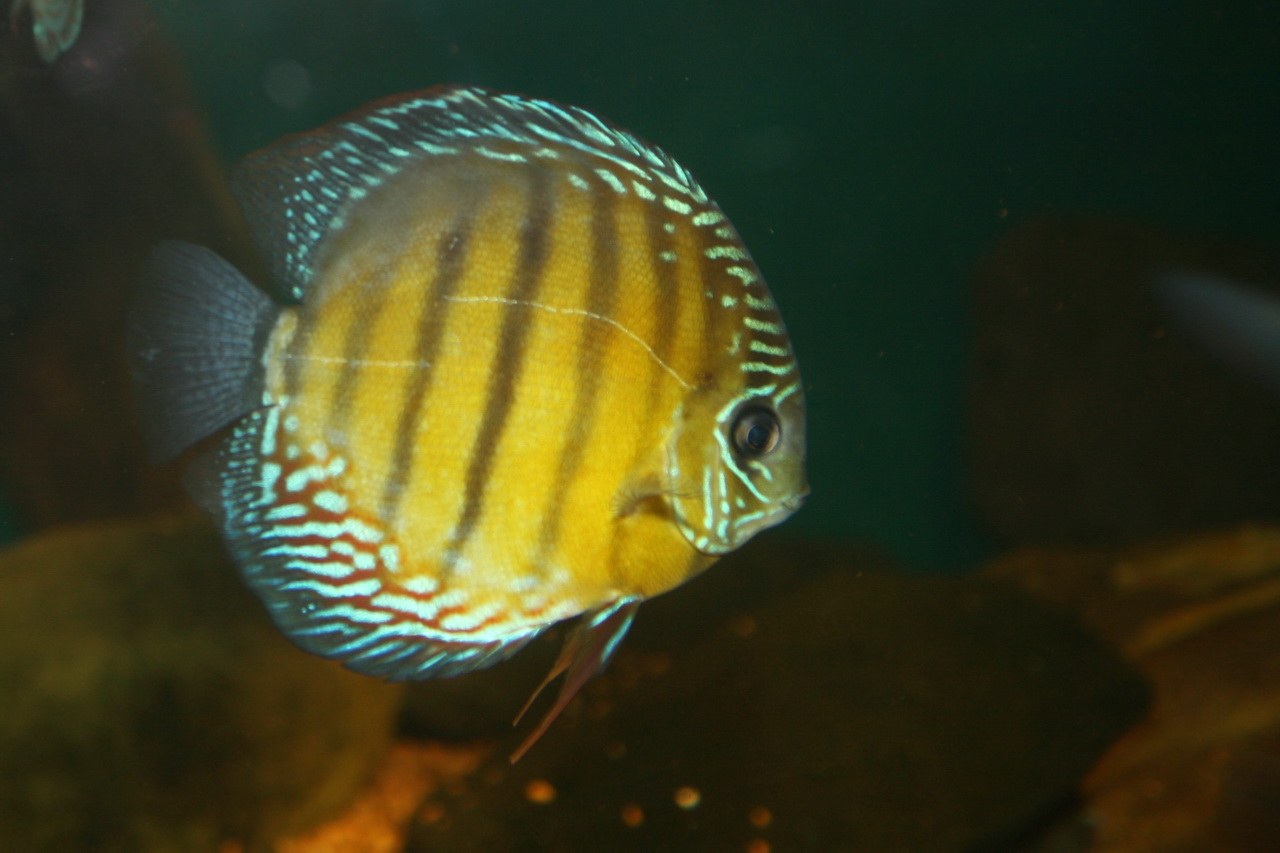
A fish shaped like a dinner plate standing on edge: almost perfectly round, laterally compressed to thinness, with colours that made it the hobby's 'king.' Wild forms carry vertical stress bars over brown, green, or blue bases; the Rio Negro's Heckel discus has a bold central bar. A century of breeding has exploded the palette — solid reds and cobalt blues, turquoise snakeskin spiderwebs, white-flecked pigeon bloods, golden albinos — each fish a hand-sized mandala. Healthy discus carry themselves upright and unhurried, fins fully spread; a dark, clamped discus is a fish filing a complaint.
Care & daily life
Discus care is a discipline: water at 82–86°F, soft and slightly acidic, with nitrate kept low by serious water changes — traditionally 30–50% several times a week, though modern keepers with heavy filtration stretch the interval. Buy discus in a group of five or six (they are social, hierarchical fish; singles pine), from a reputable breeder, ideally at 4+ inches when they are hardier than the cheaper 2-inch juveniles. Feed small, frequent, high-protein meals: discus-specific pellets, frozen bloodworms and brine shrimp, and the traditional beef-heart mixes fed by breeders. Everything else — tankmates, decor, schedule — is arranged around not stressing the discus: calm, warm, dim, and clean is the whole religion.
Health & lifespan
The Discus is generally known for the following health watch-points:
- Hole-in-the-head disease — pitting erosion linked to flagellate parasites (Hexamita/Spironucleus), stress, and water quality
- Internal parasites and 'discus wasting' in stressed or newly imported fish
- Gill flukes, common in the trade
- Bacterial infections following transport or a water-quality crash
- Chronic stress illness — the pattern underlying most of the above: a dark, hiding, non-eating discus is an emergency in slow motion
Living with a Discus
Discus suit experienced aquarists who find water chemistry a pleasure rather than a chore, and who can fund the fish (quality adults are among the priciest freshwater fish), the heating bill, and the changing water. They reward that devotion with the closest thing the freshwater hobby has to royalty holding court. They do not suit beginners, mixed rowdy communities, or anyone whose maintenance style is 'when I remember' — discus remember everything.
History
Discus come from the Amazon's slow blackwater margins — the Rio Negro and similar flooded forests — where groups drift among submerged wood in water warmer and softer than almost any other fish habitat. The Heckel discus was described in 1840; serious aquarium keeping began in the mid-1900s, and German, then Asian, breeders (Singapore, Malaysia, Thailand) turned the fish into a global luxury breed with named strains and show competitions. Wild discus are still collected seasonally, but the modern hobby runs on farm-bred varieties.