Overview
The clown loach is the aquarium hobby's most successful con trick, played by nobody on purpose: a fish so cute, comic, and personable at two inches that almost nobody asks what it becomes. What it becomes is a foot long. Add the rest of the fine print — it needs five of its own kind for company, water at the warm end of tropical, two decades of lifespan, and it clicks audibly at dinner — and the clown loach stops being an impulse buy and becomes what it should always have been: a flagship species for big tanks, kept by people who chose it deliberately. The tragedy is never the fish, which is wonderful. It is the 20-gallon tank it was sold into.
Temperament & personality
Clowns are the bottom's socialites: a group maintains a visible hierarchy (the largest, often a female, is unmistakably in charge), squabbles theatrically over sleeping caves, then piles into the same cave anyway. They click at food, surf the current, play in the filter outflow, and sleep on their sides like fallen dominoes. Shy in small numbers and daylight glare, they turn bold and clownish — the name is earned — in a proper group in a big tank. Individuals are recognisable within weeks, and the group's dusk emergence is a daily event keepers schedule around.
Appearance
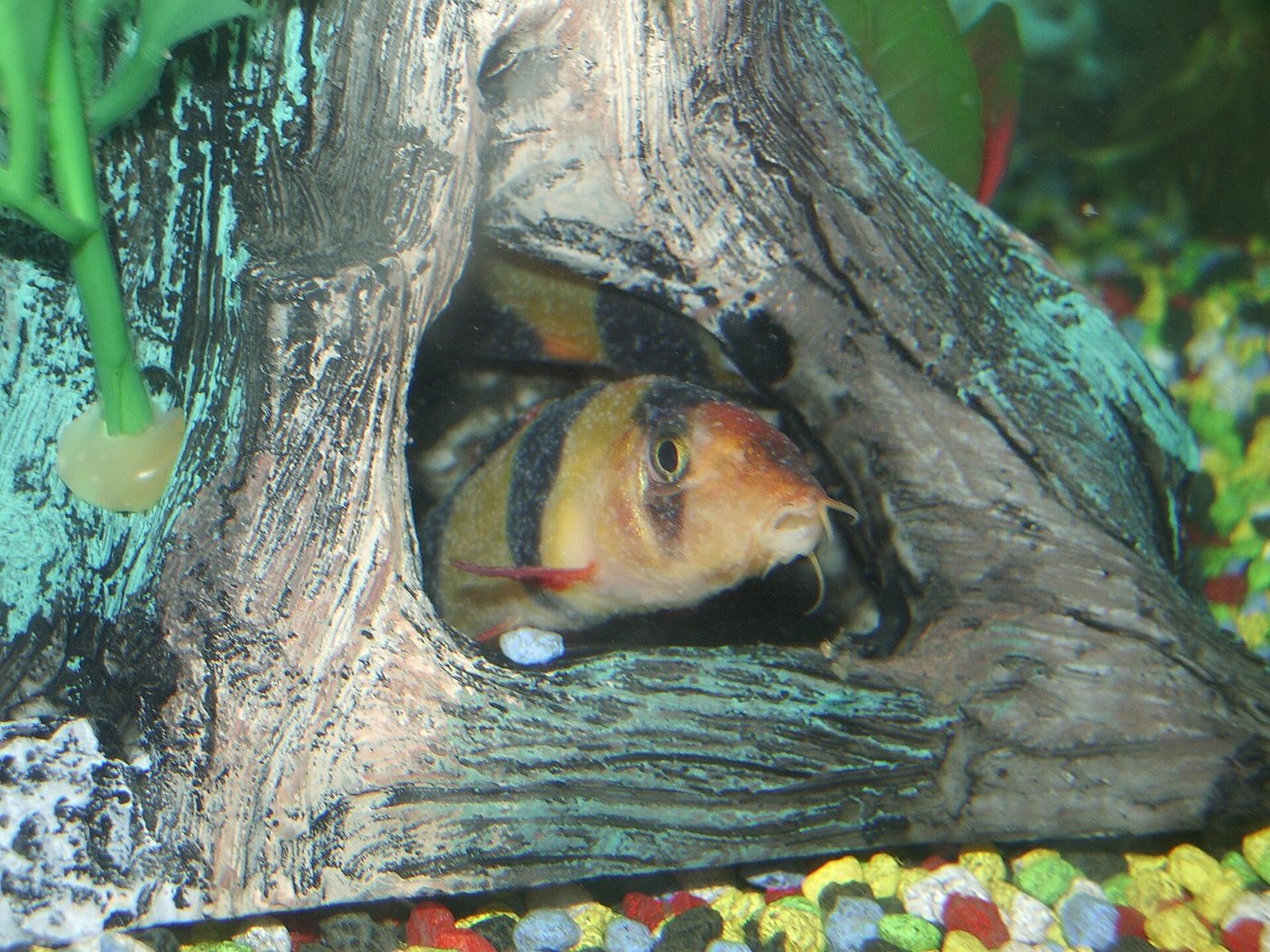
A clown loach in full dress is unmistakeable: a plump, torpedo-shaped loach in vivid orange wrapped with three broad black bands — one through the eye, one mid-body, one at the tail base — with red-tinged fins and four pairs of whiskery barbels around a small downturned mouth. Under the eye sits a folded spine the fish can erect when threatened, a genuine handling hazard for nets and bare hands. And the size: the two-inch striped charmer in the shop is a juvenile of a fish that will add an inch a year for years, thickening into a foot-long, deep-bodied adult that no longer fits the ornament it hides in.
Care & daily life
Plan for the adult, at purchase, in writing: a group of five or more, in at least 75 gallons, with 100–125 gallons the honest target for a lifelong school. Water at 75–86°F — warm — soft to neutral, with strong filtration, real current, and oxygen to match a river fish's metabolism. Furnish soft sand, smooth rocks, and more caves and tubes than fish (loaches squabble over prime sleeping spots and famously pile into one together). Feed sinking omnivore fare after lights-dim: pellets, wafers, bloodworms, snails (pest snails vanish), blanched vegetables — they are enthusiastic, messy, whole-tank feeders. Medications: halve nothing by default, but read labels literally — loaches are scaleless and copper and formalin hit them harder; raise temperature and use loach-safe ich treatments. A lid is essential; a clown loach explores overflow boxes and filter intakes with suicidal curiosity.
Health & lifespan
The Clown Loach is generally known for the following health watch-points:
- Ich — clown loaches are the hobby's canary, often the first to show white spot because they are scaleless; check them first whenever anything is off
- Skinny disease — chronic wasting from internal parasites or bacterial infection in wild-caught fish; fatten new purchases carefully
- Sensitivity to copper and standard-strength medications — scaleless skin absorbs what scaled fish tolerate
- Oxygen hunger in warm, still water — warm tanks plus weak aeration equals gasping loaches
- Hole-in-the-side injuries and net damage from the erectile cheek spine — bag, never net, an adult
Living with a Clown Loach
Clown loaches suit keepers with a genuinely large, warm, well-filtered tank and a taste for long-term, characterful groups — they are arguably the most pet-like bottom fish in the hobby. They are a poor purchase for snail control in ordinary community tanks, for anyone whose 'upgrade later' has no date attached, and for keepers of slow, delicate tankmates their feeding-time exuberance would sandblast. Bought eyes-open, into the right system, a clown group is a twenty-year delight; bought on impulse, it is a slow-motion welfare problem with stripes.
History
Clown loaches come from the great rivers of Sumatra and Borneo in Indonesia, migrating seasonally between main channels and flooded forests to spawn — a journey the aquarium cannot reproduce, which is why virtually every clown loach in trade is wild-caught and captive breeding remains a scientific event rather than an industry. In the hobby since the 1930s–50s, their export built riverside livelihoods in Kalimantan and Sumatra, and their export sizes keep creeping smaller as demand outpaces big fish. The clicking, the contortions, the sleeping pile — aquarists have adored them for seventy years; the eternal problem is only the fine print of their size.