Overview
A ferret is not a cage pet that occasionally comes out; it is a small predator that happens to sleep in a cage between adventures. Domesticated for hunting, a ferret's day divides into deep sleep and ecstatic play — the famous 'weasel war dance' of hops, twists, and open-mouthed bouncing. Before anything else: legality. Ferrets are illegal in California and Hawaii, banned in New York City, permit-only in places like Rhode Island and Washington DC, and prohibited in some countries entirely. Checking first is part of responsible buying.
Temperament & personality
Curious, persistent, joyful, and completely unbothered by rules. Ferrets steal and stash — socks, keys, anything soft or rubbery — and regard every closed door as a personal challenge. They bond strongly with people and with each other, play hard in company, and then fall asleep so deeply they can appear lifeless ('dead sleep'). It is a personality people either adore or cannot live with; there is little middle ground.
Appearance
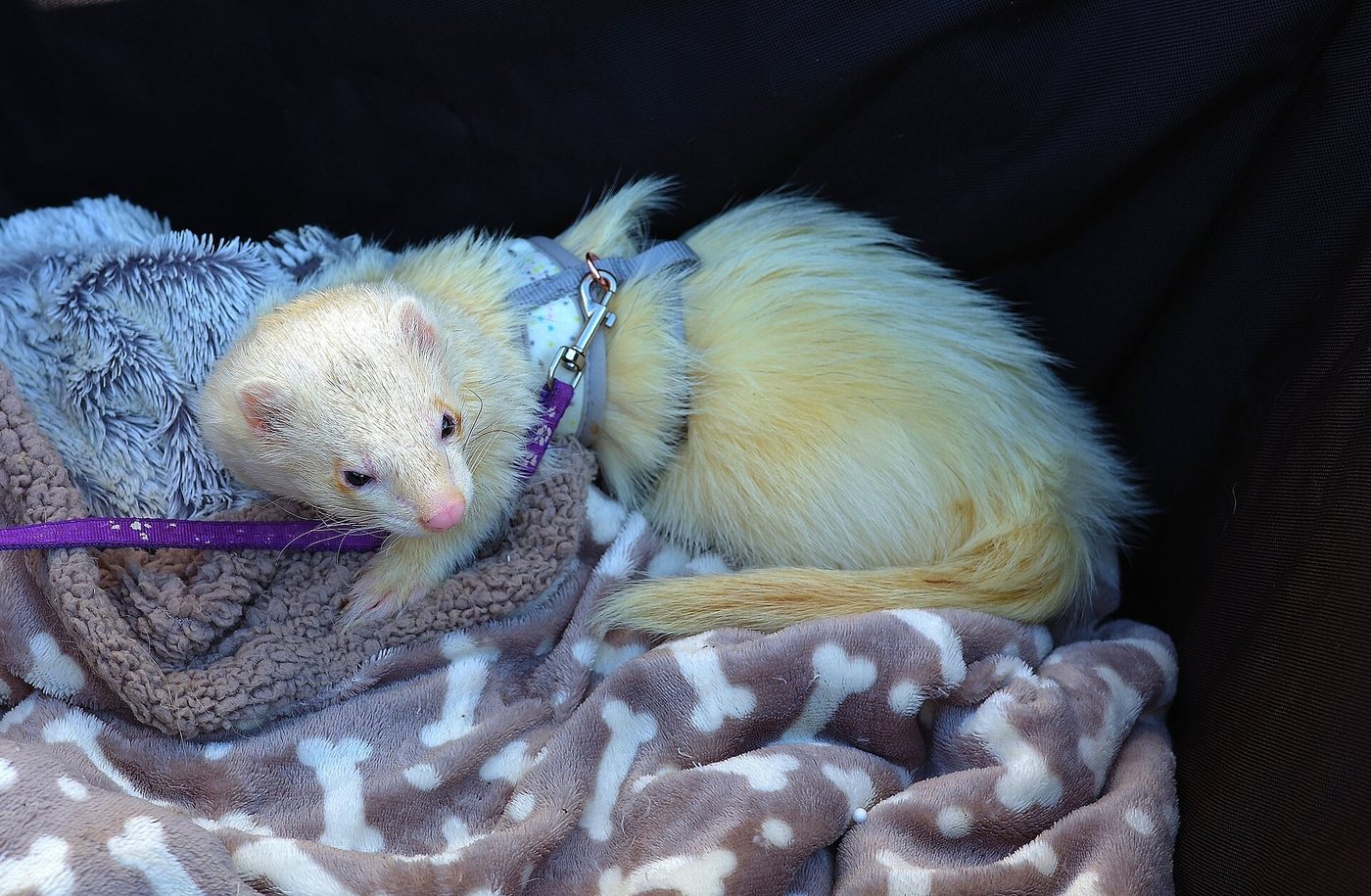
A long, low, tube-shaped mustelid with short legs, small rounded ears, a pointed face, and a thick tail. Coat colours range from the wild-type sable and polecat markings through albino to silver, cinnamon, and patterned 'panda' and 'blaze' types. Males (hobs) are noticeably larger and heavier-headed than females (jills). A healthy ferret should feel like muscular, furry liquid — they bend in ways that seem anatomically improbable.
Care & daily life
Feed a quality high-protein, high-fat ferret kibble or a properly balanced raw diet; ferrets imprint on food young, so transitioning an adult is slow work. Provide several hours of supervised free-roaming daily in a ferret-proofed room — they will open cupboards, steal soft objects, and sleep in the laundry. Ferrets cannot produce their own scent defence but do have a natural musky odour; weekly bedding washes help more than bathing, which strips the coat and increases oil production. Train litter use with boxes in corners, and expect enthusiastic, nippy play from youngsters that must be taught manners.
Health & lifespan
The Ferret is generally known for the following health watch-points:
- Adrenal gland disease — hair loss and behaviour changes in middle-aged ferrets, linked to early neutering and indoor light cycles
- Insulinoma — pancreatic tumours causing low blood sugar, weakness, and seizures; sugary treats make things worse
- Lymphoma, a common ferret cancer
- Gastrointestinal blockages — ferrets swallow rubber, foam, and fabric, and it is a leading emergency
- Influenza — ferrets catch human flu, and can give it back
Living with a Ferret
A ferret household is a ferret-proofed household: blocked gaps (anything your head fits through, a ferret's body follows — and their heads fit most places), locked cupboards, no reclining sofas without checks. They suit adults and older teens who want an interactive, dog-like small pet and can give several hours of daily play and supervision. They are poor pets for young children, light sleepers in studio flats, or anyone who cannot tolerate musk.
History
Ferrets were domesticated from the European polecat at least 2,000 years ago, most likely around the Mediterranean, and put to work: hunting rabbits ('ferreting' is still the verb), clearing rats from ships and barns, and even running cables — ferrets carried wiring through conduits at NASA facilities, aircraft factories, and Buckingham Palace events. They were also kept for fur ('fitch'). The modern pet ferret, especially from large North American breeders, is a relatively recent companion with a relatively fragile health profile.