Overview
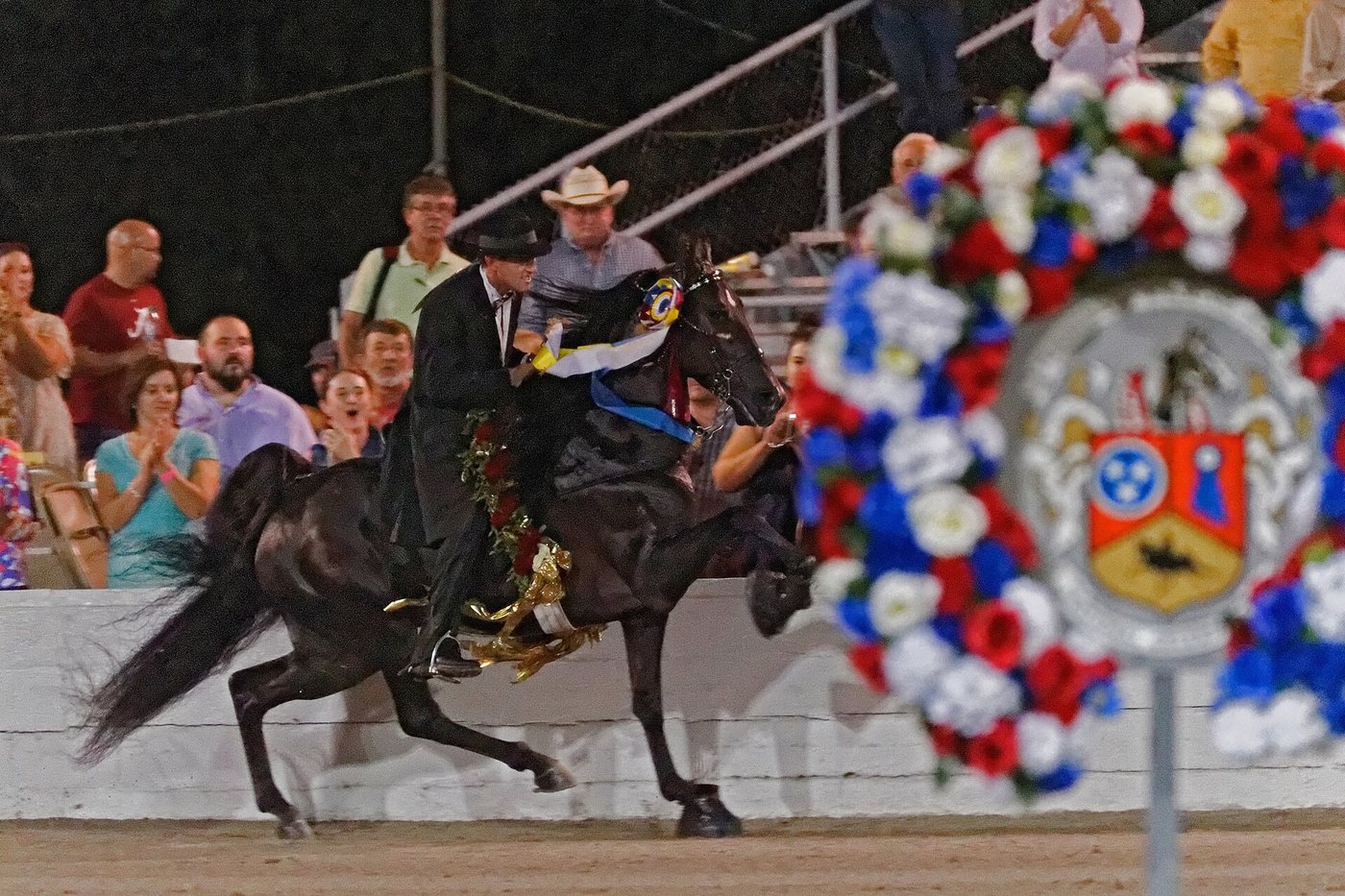
The Tennessee Walking Horse was bred for one glorious purpose: carrying a rider all day across Southern farmland in perfect comfort. Its answer is the running walk — a natural, inherited four-beat gait performed at trail speed with a nodding head and a glide that barely disturbs the rider. Developed in Middle Tennessee from Narragansett Pacer, Standardbred, Morgan, and Thoroughbred blood, the Walker became the quintessential American pleasure and trail horse: gentle, sure-footed, and smooth enough to ride for hours without posting, bouncing, or regret.
Temperament & personality
Walkers are famously mellow — docile, people-loving, and unflappable, with a ground-covering confidence that makes them beloved trail mounts. They were bred as the family and plantation horse of the South, expected to be caught from the field and ridden by anyone, and that easygoing temperament survives intact in the modern flat-shod breed. Few breeds are as beginner-friendly in both spirit and ride.
Appearance
A refined but substantial saddle horse: a pretty, intelligent head on a well-arched neck, a short strong back, powerful hindquarters built to drive the overstriding gait, and a full mane and tail. Types range from the lighter show-ring horse to the solid trail type. In motion the horse is unmistakable — head nodding in time, hind legs reaching far under and past the front footprints, ears flopping loosely at the running walk.
Care & daily life
Care is standard saddle-horse management: forage-based feeding with weight control (Walkers are often easy keepers), daily turnout, and regular trimming or light shoeing matched to trail mileage. The gait is inherited, not trained — no special equipment is needed, or should be used, to produce it. Buyers should choose flat-shod or keg-shod horses from pleasure and trail lines, where the natural gaits shine without apparatus, and ask any seller directly about shoeing practices.
Health & lifespan
The Tennessee Walking Horse is generally known for the following health watch-points:
- Generally a hardy, sound, long-lived breed with no dominant inherited disease identified
- Soring is the breed's welfare scandal, not a disease: chemical or mechanical injury inflicted in parts of the padded show world. It is illegal under the Horse Protection Act — buy flat-shod horses, ask about shoeing, and walk away from stacked pads
- Hoof balance matters for gait quality; long toes and heavy shoes distort the natural running walk — the breed does best on ordinary, correct farriery
- Easy-keeper weight gain and its laminitis consequences on lush pasture
- Standard trail-horse care applies: teeth, joints under mileage, and conditioning for long rides
Living with a Tennessee Walking Horse
Tennessee Walking Horses suit trail riders, pleasure riders, older riders, and anyone whose back demands the smoothest ride in the horse world. They ask for ordinary saddle-horse care and give back hours of genuinely comfortable riding across a 25–30-year life. The one owner duty specific to the breed: be a knowing buyer — support the flat-shod world with your money.
History
Middle Tennessee's limestone pastures produced the breed in the late 1800s as farmers crossed pacing and trotting stock — above all through the great stallion Allan F-1 ('Black Allan', foaled 1886, the breed's foundation sire) — for a horse that could cover ground smoothly at speed. The breed association was founded in 1935 in Lewisburg, Tennessee. A dark chapter followed in the mid-20th century: parts of the show world developed padded 'Big Lick' showing, and with it the illegal practice of soring — deliberately injuring horses' front legs to exaggerate the gait — condemned by the federal Horse Protection Act of 1970 and by the breed's own pleasure-riding majority. The modern breed's heart is the flat-shod trail horse, and that is the horse worth celebrating and buying.