Overview
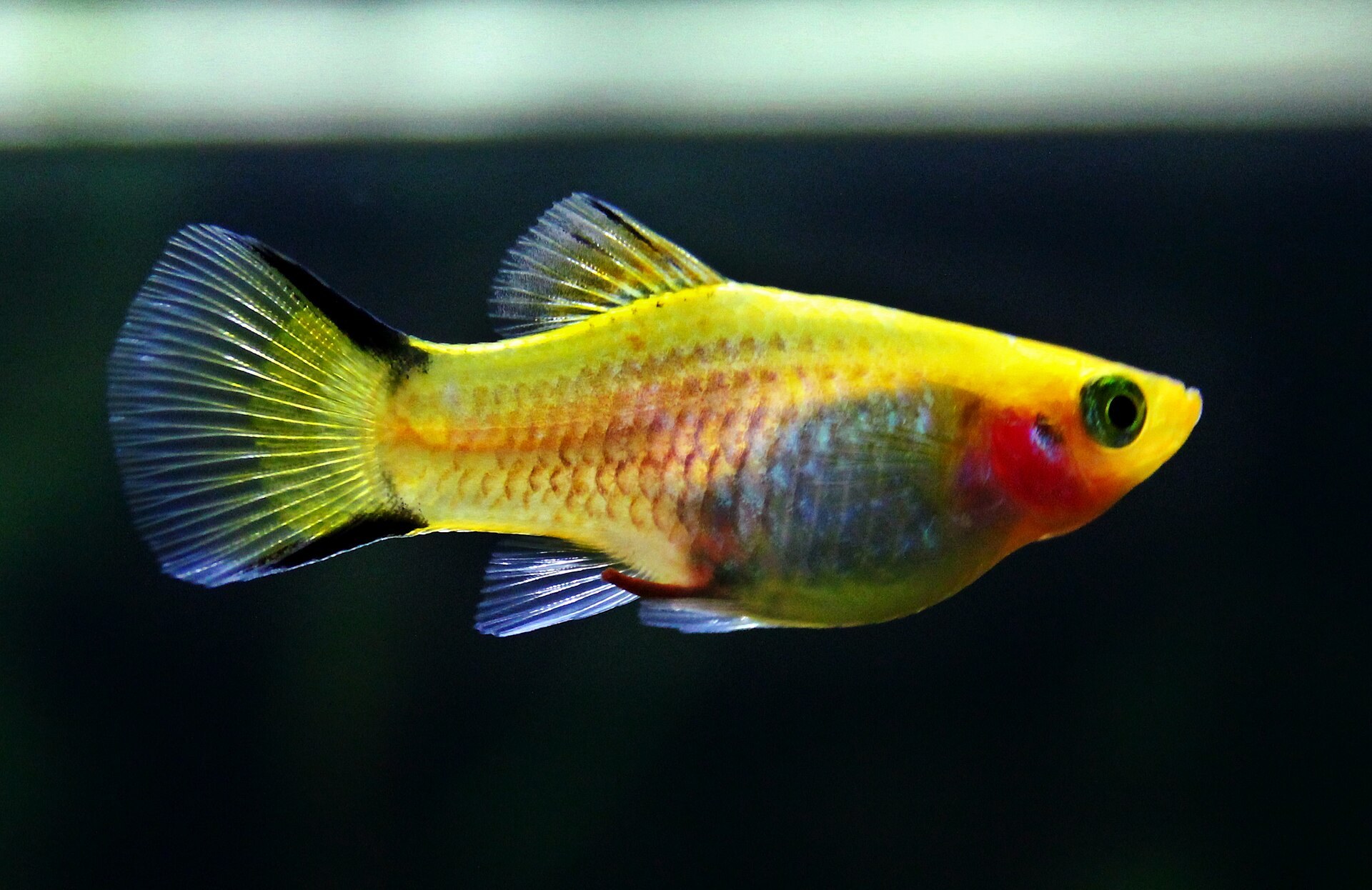
The platy is the community tank's reliable supporting actor: a stocky little livebearer in sunset orange, wagtail black-and-red, Mickey Mouse spots (the hidden outline really is on the tail stock), rainbow, sunset, and a dozen other breeder colours. It asks for the least of any fish on this shelf — decent water, regular food, company — and gives back constant gentle activity and, if males and females are mixed, a slow-motion population programme. For beginners it is arguably the most forgiving fish in the hobby.
Temperament & personality
Platies are placid, curious grazers: they nose over plants and decor for algae and microorganisms, hover hopefully at feeding spots, and generally mind their own business. Males court females with persistent but harmless enthusiasm, which is why the two-to-three-females-per-male ratio exists — one female alone gets harassed ragged. There is no schooling synchrony here, just a tankful of independent little grazers who tolerate each other beautifully.
Appearance
A platy is a guppy built by a more sensible engineer: deeper-bodied, rounder, with a short rounded tail and none of the guppy's flowing fragility. Colours come as solid blocks and bold combinations — red wagtail with a black tail, gradient sunsets, dalmatian speckles, metallic blues — and the famous Mickey Mouse platy carries a dark mark at the tail base that resolves, if you squint with goodwill, into the cartoon mouse. Males are smaller, slimmer, and brighter; females larger and rounder, with a darkening gravid spot when pregnant.
Care & daily life
Platies want undramatic basics: a cycled tank of 10 gallons or more, medium-hard alkaline water at 65–78°F, a gentle filter, and a lid (any fish can jump, and platies occasionally do). Feed once or twice daily on a quality flake or micro-pellet with a genuinely vegetable component — platies are part-time herbivores, and peas, spirulina, and blanched greens keep their guts right — finished in a couple of minutes. Then decide about babies: platies are livebearers with monthly output, so either keep one sex, or accept fry and have a plan (many simply let the community thin them, with a few survivors in planted cover). Weekly water changes keep nitrates down; platies forgive lapses better than most, which is a kindness, not a licence.
Health & lifespan
The Platy is generally known for the following health watch-points:
- Inbreeding weakness and shimmies in over-bred or poor-quality stock kept in soft, acidic water
- Ich and fin rot when chilled or stressed — the usual livebearer suite
- Columnaris ('cotton mouth') in crowded tanks
- Livebearer 'wasting' — internal parasites or chronic poor conditions thinning fish down
- Melanoma-like tumours in some heavily crossed xiphophorus strains (platy–swordtail hybrids especially)
Living with a Platy
Platies suit first tanks, children's tanks (supervised — the breeding is the lesson plan), calm communities, and anyone who wants colour without drama. They pair well with guppies, mollies, corydoras, and most small peaceful fish, and poorly with fin-nippers and big predators. The two honest commitments are small: moderate space, and a decision about fry before the fry make it for you.
History
Platies come from the slow rivers and streams of Atlantic-slope Central America, from Mexico down to Guatemala. Described to science in the 1860s, they entered the hobby early in the twentieth century and were crossed extensively with their close cousin the swordtail — nearly all modern coloured strains are of mixed parentage, which is why platy genetics became a serious scientific tool for studying inherited tumours. As pets, their century of popularity rests on the simplest foundation in the hobby: they almost never cause trouble.