Overview
The guppy is the fish that built the aquarium hobby: cheap, colourful, active, hardy — and pregnant, essentially always. A livebearer that produces fully formed fry every month, the guppy turns a single purchase into a colony and a genetics hobby into colour strains that breeders guard like racehorse bloodlines. It is easy to keep and genuinely difficult to keep only a few of — the two facts that define guppy keeping.
Temperament & personality
Male guppies live for display: they flare fins, do a jerky sigmoid courtship dance at females, and otherwise patrol the tank in constant motion. Females are calmer, food-focused, and increasingly rotund. As a group they are peaceful, surface-oriented, and busy from lights-on to lights-off — the opposite of shy. The social arithmetic matters: lone females get harassed ragged by males, which is why the 2–3 females per male ratio is the hobby's standing rule.
Appearance
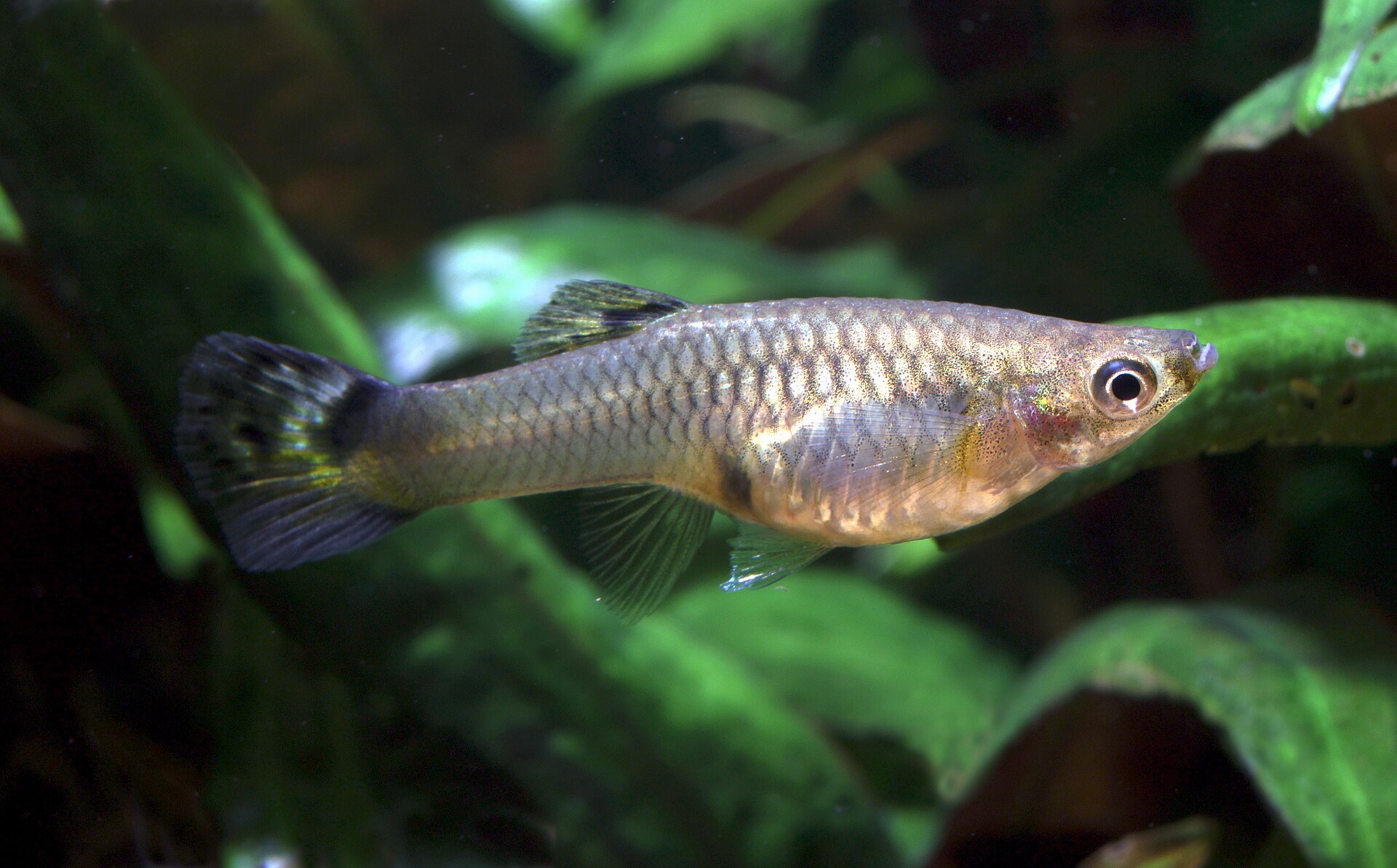
Wild female guppies are plain silver-olive; the males of the domestic strains are living confetti. Selective breeding has produced snakeskin, cobra, mosaic, and tuxedo patterning in reds, blues, greens, and metallics, with tail shapes from delta fans and lyretails to swords and spears. Males are small, slim, and all display; females are larger, rounder, and drab by design, with a dark gravid spot near the tail that deepens as pregnancy advances. In a planted tank a school of male guppies reads as drifting sparks of colour.
Care & daily life
Guppies ask for basics done steadily: a cycled tank at 72–82°F, regular water changes, gentle filtration (a sponge filter doubles as a fry sanctuary), and a lid — they jump. Feed small amounts of quality flake or micro-pellet once or twice daily, varied with baby brine shrimp, daphnia, or crushed vegetables; overfeeding fouls water faster with guppies than almost any fish their size. The central management decision is babies: either keep males only, or accept a breeding colony and plan for the fry (a separate tank, a shop that takes them, or predation in a community tank). Mixing fancy strains in one breeding tank reverts colours toward wild type within generations, which delights nobody if you bought them for the colours.
Health & lifespan
The Guppy is generally known for the following health watch-points:
- Inbreeding weakness in mass-produced fancy strains — bent spines, poor immunity, short lives
- Columnaris ('cotton mouth') and fin rot in stressed, crowded stock
- Ich and other common parasites from shop tanks
- 'Guppy disease' (Tetrahymena infestation) in weakened fish
- Old-age decline comes fast: a two-year-old guppy is a senior
Living with a Guppy
Guppies suit beginners with a 10-gallon-plus tank, classroom tanks, and anyone who enjoys a self-renewing display. The honest catch is reproductive: this is a pet that multiplies, and having a plan for fry is part of responsible guppy keeping. They suit keepers of community tanks poorly only when paired with fin-nippers like tiger barbs, whose attentions those flowing tails invite.
History
Guppies come from the streams of Venezuela, Guyana, and islands like Trinidad and Barbados. They are named for Robert John Lechmere Guppy, a naturalist who sent Trinidad specimens to the British Museum in 1866 (the fish had actually been described slightly earlier from other collections, but the name stuck). Shipped worldwide as mosquito-control fish, guppies escaped or were released across the tropics — the aquarium strain, meanwhile, was transformed by a century of colour breeding into one of the hobby's most varied animals.