Overview
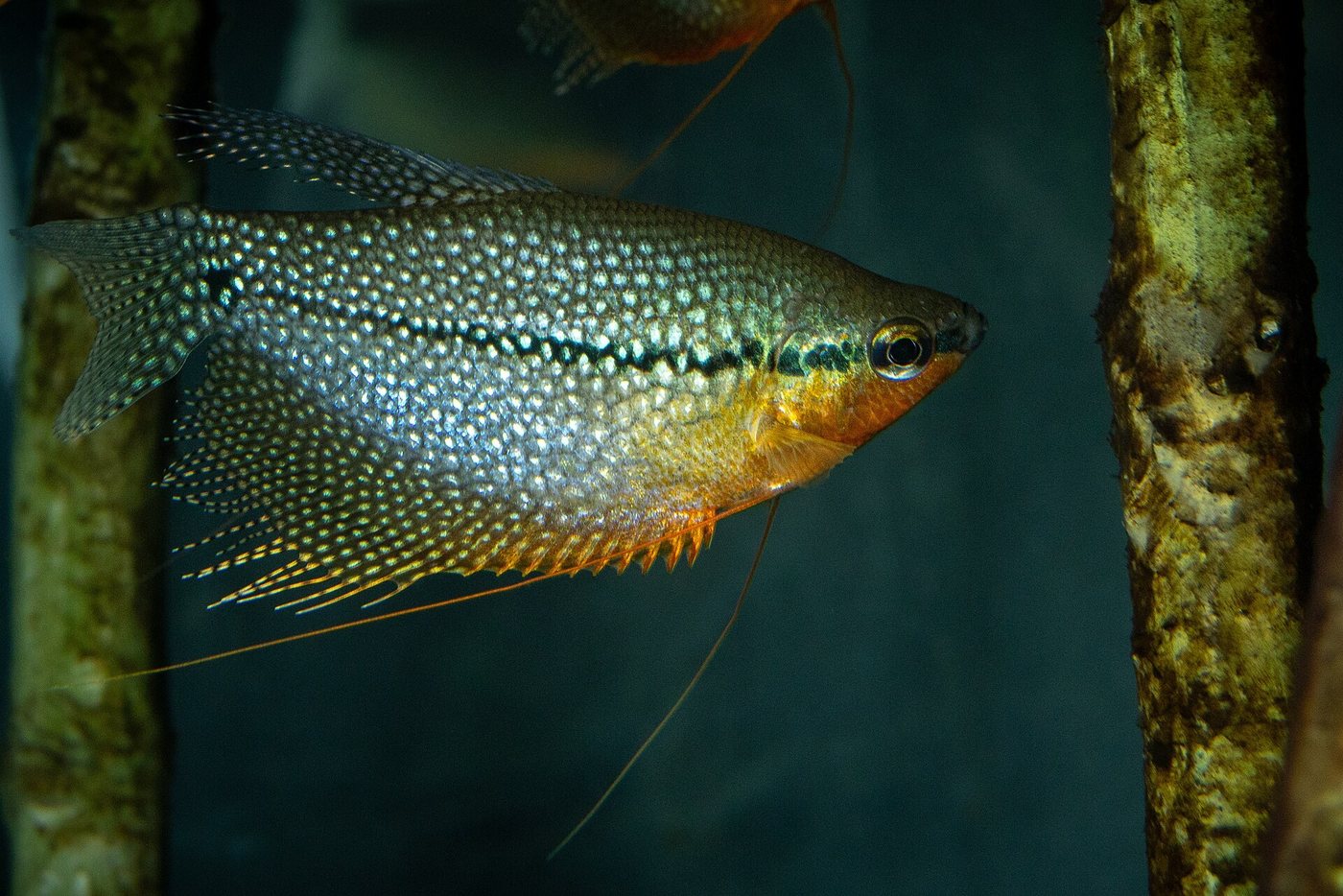
The pearl gourami is the connoisseur's default: regularly named among the most beautiful freshwater fish, and — unlike so many holders of that title — peaceful, hardy, and easygoing enough for a community tank. Its pattern is the reverse of showy: a warm umber body lit all over with mother-of-pearl flecks, dramatic only when the male's throat turns ember-orange for courtship. Where the dwarf gourami's story is now inseparable from a virus, the pearl's story is simply decades of quiet reliability: it is the gourami this site recommends first.
Temperament & personality
Pearls are shy aristocrats. They hover mid-water with fins gently rowing, explore with their feelers, and conduct their social lives at a murmur — males bubble-nest under floating leaves and herd females with displays rather than force. They startle at sudden movement early on and tame down into front-glass confidence over weeks. In mixed company they are the fish that never features in anyone's aggression story, which, in a community tank, is the highest praise available.
Appearance
A pearl gourami is a study in quiet luxury: a warm brown-gold body scattered all over with pearly white spots, like a starfield, crossed by one dark line from snout through the eye to the tail. The fins are large, lacy, and fringed; the pelvic feelers trail far behind. In breeding condition the male's throat and chest kindle to a deep orange-red — the fish's one loud statement — while females stay softer, with a rounder dorsal fin. Under tank light the 'pearls' genuinely catch and sparkle, which is how a mostly brown fish earns a place on a most-beautiful list.
Care & daily life
A 30-gallon planted tank, warm at 76–82°F, gentle filtration, floating plants overhead, and groups of plants to retire among. Unlike its dwarf cousin it is robust stock — the main requirements are warmth, calm, and a lid (gouramis breathe surface air and also jump occasionally). Stock one male with two or three females ideally; lone fish are fine but shyer. Feed floating foods like the dwarf's menu, plus quality flake and occasional vegetables; pearls are unhurried eaters best kept away from surface bullies. Tankmates should be mid-sized and mellow: harlequins, cherry barbs, corys, other peaceful gouramis. With that, maintenance is routine water changes and admiration.
Health & lifespan
The Pearl Gourami is generally known for the following health watch-points:
- Ich and velvet in new or chilled fish — the ordinary gourami risks, absent the dwarf's viral shadow
- Bacterial fin rot where water quality slips
- Stress fading and appetite loss in boisterous tanks (a management signal, rarely a disease)
- Male-on-male sparring injuries in cramped arrangements
- Old-age opacity of the eyes and general slowing in senior fish
Living with a Pearl Gourami
Pearls suit calm communities of 30 gallons and up, planted centrepiece tanks, and keepers who want a gourami without the dwarf's medical lottery. They are too slow and gentle for barb-and-cichlid roughhousing, and too large for nano tanks. The honest summary: if the dwarf gourami is a sports car with a known engine fault, the pearl is the same styling in a sedan that starts every morning.
History
Pearl gouramis come from the lowland swamps, lakes, and slow rivers of Malaysia, Thailand, and the Indonesian islands of Sumatra and Borneo — warm, plant-tangled, acidic waters. They entered the Western hobby in the 1930s and have remained in the first rank of community fish ever since, that rare case of a species whose reputation and reality agree: everything said about them being beautiful, peaceful, and tougher than they look is simply true. Wild fish are still collected locally, but the trade runs on farmed stock that has stayed mercifully healthy.