Overview
The dwarf gourami is the most beautiful headache in freshwater fishkeeping. The male — neon blue over flame-orange diagonal bands, feelers waving as he investigates the world — looks like someone painted a sunset onto a fish, and at a few dollars it seems like the easiest decision in the shop. Then the asterisk: a large share of the mass-farmed trade carries dwarf gourami iridovirus, an incurable viral disease that kills slowly and has made 'my dwarf gourami wasted away for no reason' one of the hobby's most-posted sentences. Well-bred fish in a calm planted tank are delightful, personable, and long-lived by small-fish standards. Farmed fish bought blind remain a coin flip, and honesty requires saying so on the label.
Temperament & personality
Dwarfs are shy, deliberate surface-dwellers that think with their feelers — the long pelvic rays are taste-and-touch sensors, extended to everything new: plants, tankmates, your finger at the glass. A settled male builds a small, serious territory around floating cover, bubbles a modest nest, and courts females with bent-body displays. They spook easily, hide readily, and eat timidly, which is why they starve decorously in pushy company while appearing 'fine.' In a calm tank their curiosity comes forward within days.
Appearance
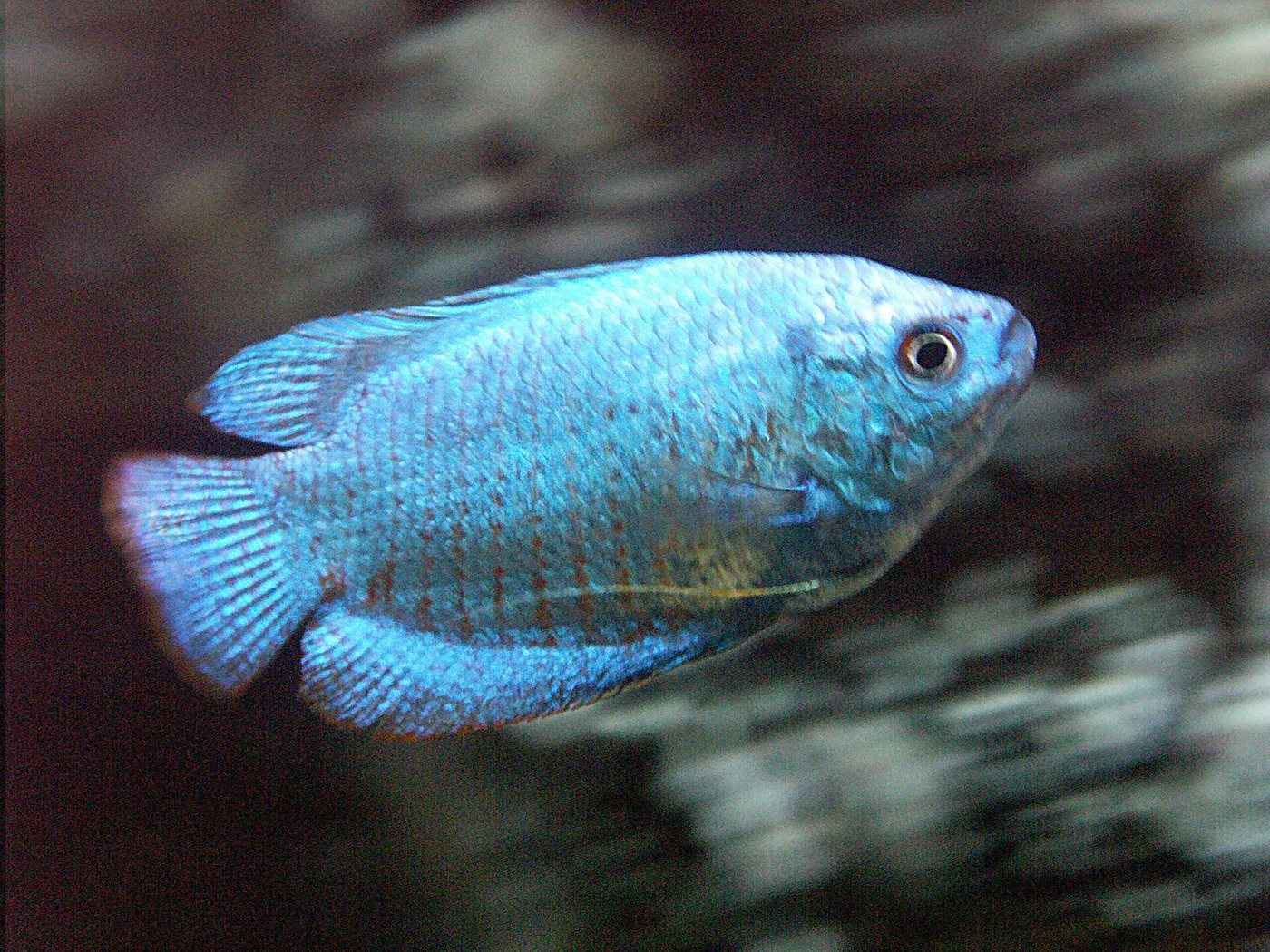
A stocky little labyrinth fish of three inches, built like a tiny angelfish with trailing pelvic feelers. Males in the classic strain glow powder-blue over orange-red bands — electric, unmistakable, and extensively re-bred into solid red, solid blue, and neon forms; females are silvery, plainer, and noticeably rounder. In poor condition the colours wash to a grey ghost of the shop display, which is itself diagnostic: the fish's colour chart is a live readout of its health and confidence, and a faded male in a bright tank is telling you something specific.
Care & daily life
Give a pair or a single male a planted 20-gallon tank (10 is the oft-quoted floor for one fish, but the fish uses and appreciates 20), warm at 76–82°F, with gentle filtration, floating plants, and dim shelter — bright stark tanks are a major cause of the classic faded, sulking dwarf. Stocking must be thoughtful: no fin-nippers, nothing that out-competes it at the surface, and other dwarf males only with real distance and broken sight lines, since males hold small, serious territories. Feed floating small foods: micro-pellets, daphnia, mosquito larvae, baby brine shrimp — they are surface hunters with upturned mouths. Above all, source carefully, quarantine if you possibly can, and never add a new dwarf to 'replace' one that died of a wasting sickness without a fallow period: DGIV persists in the environment and the new fish is the next host.
Health & lifespan
The Dwarf Gourami is generally known for the following health watch-points:
- Dwarf gourami iridovirus (DGIV) — incurable, widespread in mass-farmed stock; wasting, darkening, skin sores, sudden death
- Bacterial ulcers and 'gourami sores' — often the visible end of viral immunosuppression
- Ich and velvet under stress and chilling
- Constipation from dry-food-only diets — vary with live and frozen foods
- Chronic bullying/starvation at the surface in boisterous communities
Living with a Dwarf Gourami
Dwarf gouramis suit quiet, warm, planted tanks and patient keepers who buy carefully — from a shop that quarantines, or a local breeder — and stock the tank around a shy surface-dweller. They are a risky choice bought casually from a discount tank to brighten a rowdy community, where fading, hiding, and slow decline are the standard script. Suitability, unusually, is decided less by your tank than by your fish shop.
History
Dwarf gouramis inhabit the slow, weed-choked waters, rice paddies, and floodplains of the Ganges and Brahmaputra plains in India, Pakistan, and Bangladesh. Long a modest wild fish, they were transformed by Singapore and Indonesian farms into neon showpieces and exported in the millions — and the same intensive farming carried DGIV around the world with them, turning a hardy species into a byword for unexplained death. Local and small-scale breeders produce markedly healthier fish, and the hobby's slow swing toward them is the species' best news in decades.