Overview
The Snowshoe is one of cat breeding's happiest accidents made deliberate: a blue-eyed, pointed cat with improbably white feet and a personality that improves on both its parents. It talks like a Siamese but more sweetly, bonds like a Siamese but more calmly, and carries the American Shorthair's sturdiness underneath. Its rarity is real and its charm is considerable — if you want a sociable, long-lived, easy-care cat and can find a breeder, the Snowshoe rewards the search.
Temperament & personality
Sweet, social, and devoted. Snowshoes are archetypal 'velcro cats' — they choose a person (while remaining friendly to everyone), then organise their day around them: supervising work, joining conversations in a soft, melodic voice, and claiming the lap the moment it appears. They are playful, water-curious, and smart enough to learn doors, fetch, and the location of the treat cupboard. More mellow than a full Siamese, but with the same need to be involved in absolutely everything.
Appearance
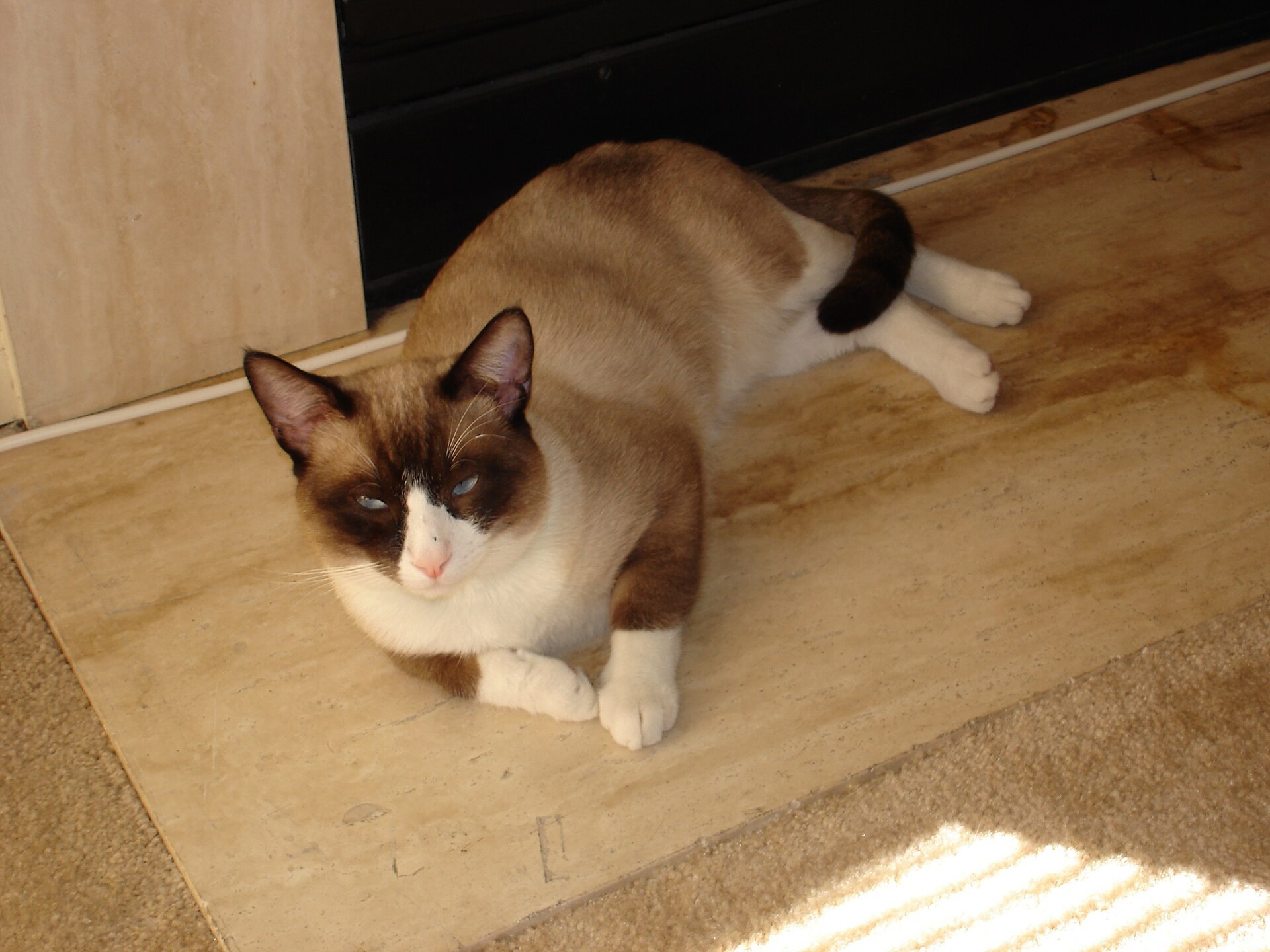
The Snowshoe is a Siamese in evening dress: a short, glossy pointed coat — seal, blue, chocolate, or lilac darkening on ears, mask, legs, and tail — set off by crisp white 'snowshoe' feet, a white muzzle blaze (ideally an inverted V), and vivid blue eyes. The body is the surprise: where a modern Siamese is tubular and fine, the Snowshoe is sturdier and more rounded, thanks to its American Shorthair heritage — medium-sized, well-muscled, and graceful rather than extreme. Kittens are born white, with points and markings emerging over the first two years.
Care & daily life
The short, single coat is one of the easiest in the pedigree world: a weekly brush or a hand-groom removes loose hair, and shedding stays light. Snowshoes are social, busy cats who need company — they bond hard, follow their person, chat about everything, and get lonely and vocal if left alone all day; a companion cat or dog is strongly recommended. Provide climbing, interactive play, and supervised adventure (many are harness-trainable), and keep this people-cat strictly indoors.
Health & lifespan
The Snowshoe is generally known for the following health watch-points:
- Generally a healthy, hardy breed benefiting from its two-breed foundation
- Crossed eyes and kinked tails — cosmetic throwbacks from Siamese ancestry — appear occasionally; breeders select against them and they do not affect health or lifespan
- No breed-specific DNA-screened diseases are established; ask about general health and longevity of the line
- Dental disease and indoor weight gain are the routine management issues in a long life
Living with a Snowshoe
Snowshoes are people-cats for people who are actually home: they attach deeply (often singling out one favourite), follow, chat, and supervise. They suit families, multi-pet homes, and anyone wanting a sociable, interactive companion, and they do particularly well with a second animal for company. They are a poor match for empty-all-day households, where a Snowshoe will be lonely, loud about it, and bored into mischief.
History
The Snowshoe began in 1960s Philadelphia, when Siamese breeder Dorothy Hinds-Daugherty found three kittens with white feet in a normal litter and decided to breed for the look deliberately, crossing pointed cats with a bicolour American Shorthair. The result — Siamese colour and voice, white markings, sturdier build — she named the Snowshoe for its white paws (the breed was briefly called 'Silver Laces'). The genetics proved fiddly and the breed nearly died out in the 1970s, surviving through a few persistent breeders before TICA championship recognition in 1994 revived interest. It remains one of the rarest recognised breeds, kept uncommon by the sheer difficulty of landing the white in the right places.