Overview
No breed divides the room like the Savannah. On one side: the most striking cat in existence, a tall, spotted, dog-loyal athlete that walks on a leash, plays in water, and can leap eight feet straight up. On the other: a genuine wild hybrid whose early generations challenge owners, landlords, insurers, and legislators, and whose popularity has outrun many buyers' preparation. Both descriptions are true. This profile treats the Savannah as what it is — a spectacular animal and a serious responsibility — and stresses the two questions that matter: which generation, and is it legal where you live?
Temperament & personality
Confident, curious, and intensely loyal. Savannahs pick their people and commit — following them room to room, greeting them at the door, learning leash walks, fetch, and sometimes the location of every latch in the house. They are among the most intelligent and active of all breeds, playful for years, and famously fond of water. Early generations can be shyer with strangers and more single-person in their loyalty; later generations are more uniformly sociable. The serval-style hiss startles visitors but is often simply how a Savannah says hello.
Appearance
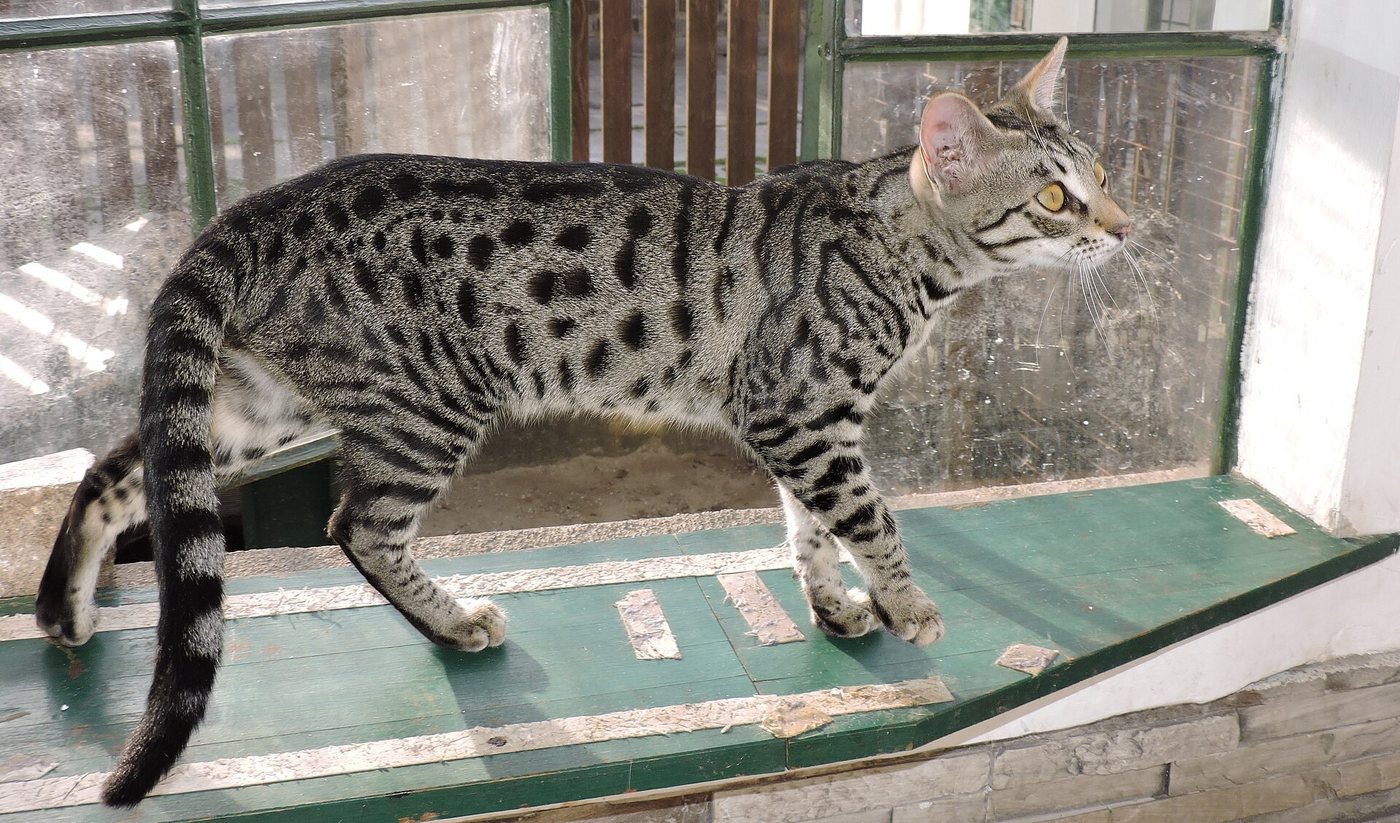
The Savannah is the tallest domestic cat breed: long legs, a long neck, large upright ears with pale 'ocelli' spots on the back, and a short, dense coat marked with bold dark spots on gold, silver, or smoke. The body is lean and athletic, built like a small cheetah. Size depends heavily on generation: F1 males (half serval) can stand over 17 inches at the shoulder and weigh 20–25 pounds, while later generations (F4–F5 and beyond) look like very large, leggy spotted housecats of roughly 12–18 pounds. The wild expression — hooded eyes, tear-stain markings like a cheetah's — softens as generations progress.
Care & daily life
Be honest about what this cat needs. Early generations (F1–F3) require serious space — tall climbing structures, secure enclosures or catios, and ideally leash walks, since Savannahs famously learn harnesses and door handles. They are escape artists of the first rank; childproof latches are not a joke. Many breeders feed early generations a meat-heavy or raw diet. All Savannahs are high-energy, easily bored, and destructive when understimulated, and they form intense bonds — rehoming is hard on them, which is how too many end up surrendered. Later generations (F5+) are far closer to an ordinary — if athletic — pet cat. Research your local law before anything else: legality varies enormously (see below), and get permits in writing.
Health & lifespan
The Savannah is generally known for the following health watch-points:
- Generally healthy and long-lived for a large breed, but ask about hypertrophic cardiomyopathy (HCM) screening — ultrasound screening is recommended in breeding cats, as in Bengals
- Pyruvate kinase (PK) deficiency — an inherited anaemia found in serval-derived lines; a DNA test exists and breeders should use it
- Early generations may have a smaller liver relative to body size — a serval trait, not a disease, but worth your vet knowing
- Nutrition matters: meat-based diets with adequate taurine are standard breeder advice, particularly for early generations
- The real-world health risk is behavioural, not genetic: understimulated or illegally kept Savannahs are surrendered at high rates
Living with a Savannah
A Savannah is right for a small, specific audience: experienced cat people with space, security, money, legal clarity, and a genuine appetite for an intense, athletic, highly interactive animal. Later generations fit active households and bond brilliantly with dogs and older children; early generations belong with specialists, full stop. They are wrong for first-time owners, small apartments, homes with free-roaming small pets, and anyone in a jurisdiction that restricts hybrids. Choose the generation with your head, not the photograph.
History
The Savannah began on 7 April 1986, when Pennsylvania breeder Judee Frank's male African serval was housed with her Siamese and produced a single kitten — named Savannah — that combined the serval's size and markings with domestic tractability. Patrick Kelley, who had been dreaming of exactly this cross, bought Savannah's daughter and, working with breeder Joyce Sroufe, developed the breed through the 1990s, using Bengals, Egyptian Maus, and other spotted domestics as outcrosses. TICA accepted the breed in 2001 and granted championship status in 2012. Generations are labelled by filial number — F1 is half serval, F2 a quarter, and so on — and early-generation males are typically sterile until around F5, one of many reminders that this breed sits closer to the wild than any other in the show hall.