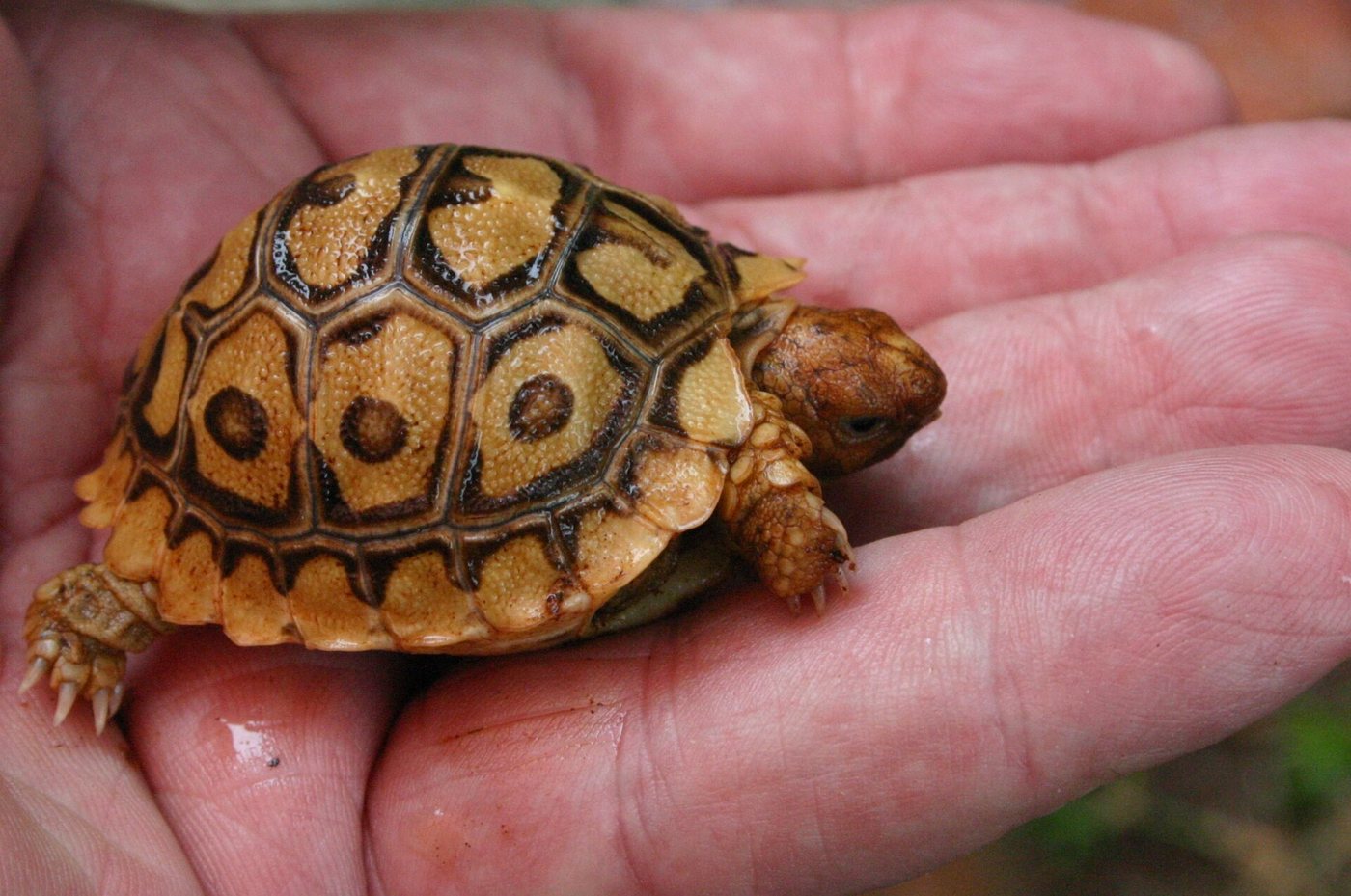
Overview
The leopard tortoise is the savanna made portable: a high-domed grazer wearing a shell of cream and black rosettes that breaks its outline in dappled grassland light. It is Africa's fourth-largest tortoise and one of the few true grazing tortoises — an animal built to walk and eat grass all day. Gentle and undemanding in temperament, it is demanding in the one currency beginners underestimate: space. A leopard tortoise adult needs a garden, not a table, and a lifespan that may approach a century.
Temperament & personality
Leopards are calm, rather shy grazers that settle into strong routines: out to bask, off to graze a circuit, back to a favourite sleeping corner. They rarely show the pushy boldness of a Russian tortoise, but they learn their keepers and their feeding spots and become quietly confiding. They do not dig like Russians (though they can bulldoze), and they are not climbers; their vice is simply size — an adult's grazing rounds and strength need planning around. Males can spar by shell-ramming; groups need real space.
Appearance
The shell is the signature: a high, steep dome in straw-yellow to cream, each scute carrying bold black blotches and speckles that form the 'leopard' pattern — most vivid in youngsters, softening and darkening with age in some adults. Unlike many tortoises there are no bright colours anywhere else: head, legs, and skin are plain yellowish-brown. The species lacks a nuchal scute (the small scute behind the head), an identification quirk. Females grow larger than males and have shorter tails; old East African females are genuinely imposing animals.
Care & daily life
Plan this tortoise backwards from the adult: a 30–40 lb grazer that needs a large, secure outdoor pen in a warm climate (or a heated shed-and-paddock setup in cooler ones), with grazing turf, shade, a dry shelter, and fencing it cannot push through or dig under. Youngsters start indoors in a 4×2 ft table with a 95–105°F basking spot, ambient in the 80s, UVB, and — importantly — a humid hide around 70–80% humidity, because babies raised bone-dry pyramid badly. Feed the grazing diet: grasses and grass hay as the staple, weeds and leafy greens for variety, calcium dusted regularly, almost no fruit and never protein-rich 'tortoise pellets' marketed for other species. Leopards are cold-sensitive compared with Mediterranean tortoises: damp cold is their enemy, and adults should not sit below about 70°F at night. Shallow water for drinking; they do soak occasionally.
Health & lifespan
The Leopard Tortoise is generally known for the following health watch-points:
- Shell pyramiding in juveniles raised too dry or fed too rich — humid hides and a grass diet are the prevention
- Respiratory infections — this species tolerates dry cold poorly and damp cold worst of all; runny nose means act
- Bladder stones from dehydration and overly rich diets
- Metabolic bone disease without UVB and calcium, as in all tortoises
- Internal parasites — fecal-check any new animal
Living with a Leopard Tortoise
Leopard tortoises suit keepers with genuine outdoor space in a warm or well-equipped climate and a planning horizon of half a century or more — this is a garden tortoise in the full sense, closer to keeping a small sheep than a tank pet. They are wonderful for grazing lawns (untreated by chemicals), placid around calm households, and hopeless for apartments, small tables beyond babyhood, or cold damp gardens without serious heated infrastructure. If the adult's size and lifespan both fit your life, few tortoises are more rewarding.
History
Leopard tortoises graze the savannas of eastern and southern Africa, from Ethiopia and Sudan down to South Africa — the widest-ranging of the African tortoises and the continent's fourth largest. Grassland peoples have known them for millennia, and the species' beauty made it a staple of the international pet trade, historically wild-collected in large numbers; today captive-bred animals are widely available and are the responsible choice. Unlike Mediterranean species, leopards do not truly hibernate — their evolution is tropical, a fact written into their intolerance of cold.