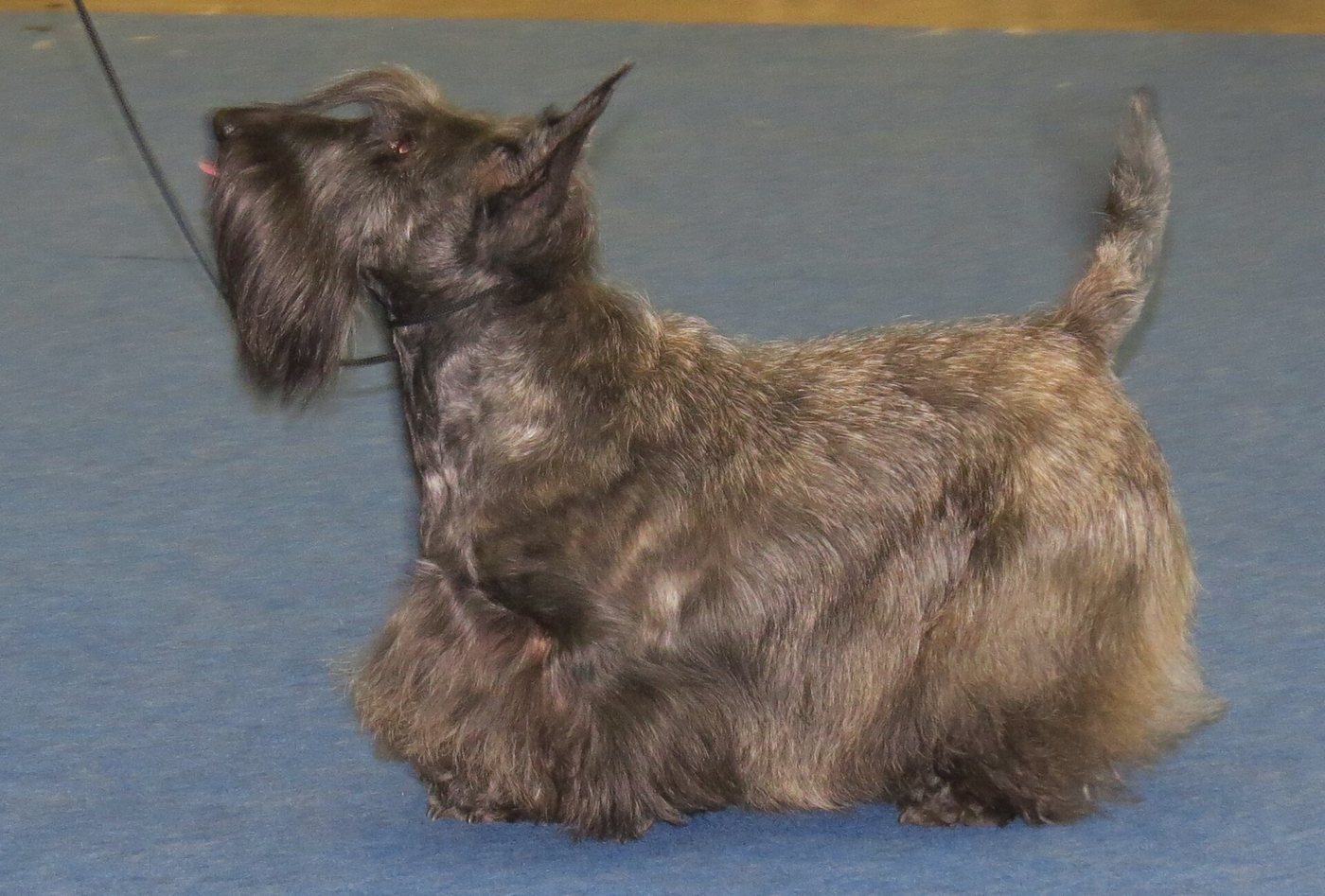
Overview
The Scottish Terrier is the most self-possessed dog in the terrier group: a sturdy, low-slung Highland earth dog with a long bearded head and an air of complete confidence in its own judgement. Bred to face badgers underground alone, the Scottie never learned to look to humans for instructions — which is precisely its charm, and its challenge.
Temperament & personality
Independent, confident, and spirited, with a dry, almost solemn dignity that owners find hilarious. Scotties are loyal and affectionate in a restrained, adult way — devoted, not fawning. They are bold with other dogs regardless of size, sharp-eyed watchdogs, and famously stubborn in training. Early socialization and patient, consistent handling bring out a companion of real character.
Appearance
Unmistakable profile: a short-legged, sturdy terrier with a long head, piercing almond eyes under heavy eyebrows, a beard, erect ears and tail, and a hard, wiry double coat in black, wheaten, or brindle. The Scottie's silhouette — low, long, and dignified — has made it a design icon for over a century.
Care & daily life
Scotties need about an hour of exercise daily and enjoy brisk walks and play, though they are not built for heat or long runs. The wiry coat needs brushing two to three times a week and hand-stripping or clipping several times a year; the beard wants a wipe after meals and water. Training should be consistent and reward-based — force achieves nothing with this breed.
Health & lifespan
The Scottish Terrier is generally known for the following health watch-points:
- Bladder cancer (transitional cell carcinoma) — Scotties have an exceptionally high risk, roughly 18–20 times that of the average dog; urinary signs should always be checked promptly
- Scottie cramp — an inherited serotonin-related movement disorder causing temporary leg stiffening under excitement or exercise; not painful, and dogs recover in minutes
- Von Willebrand's disease type III — a bleeding disorder, DNA-testable
- Craniomandibular osteopathy ('lion jaw'), a painful jaw-bone growth seen in young Scotties
- Cerebellar abiotrophy and hypothyroidism are also reported in the breed
Living with a Scottish Terrier
Suits households that appreciate a self-reliant, dignified character: singles, couples, and families with older children. Scotties adapt well to apartments and houses alike, need moderate exercise, and make excellent watchdogs. They are not social butterflies — most prefer their own people and keep terrier suspicion of visiting dogs and rodents.
History
Terriers of this type worked the Scottish Highlands for centuries, going to ground after fox and badger. The modern breed was standardised around Aberdeen in the late 1800s — hence its older name, the Aberdeen Terrier — by keepers like John Naylor and Captain Gordon Murray. Its nickname 'Diehard' came from its refusal to quit. Scotties became cultural icons in the 20th century, from Roosevelt's Fala onward, and the breed was recognised by the AKC in 1885.