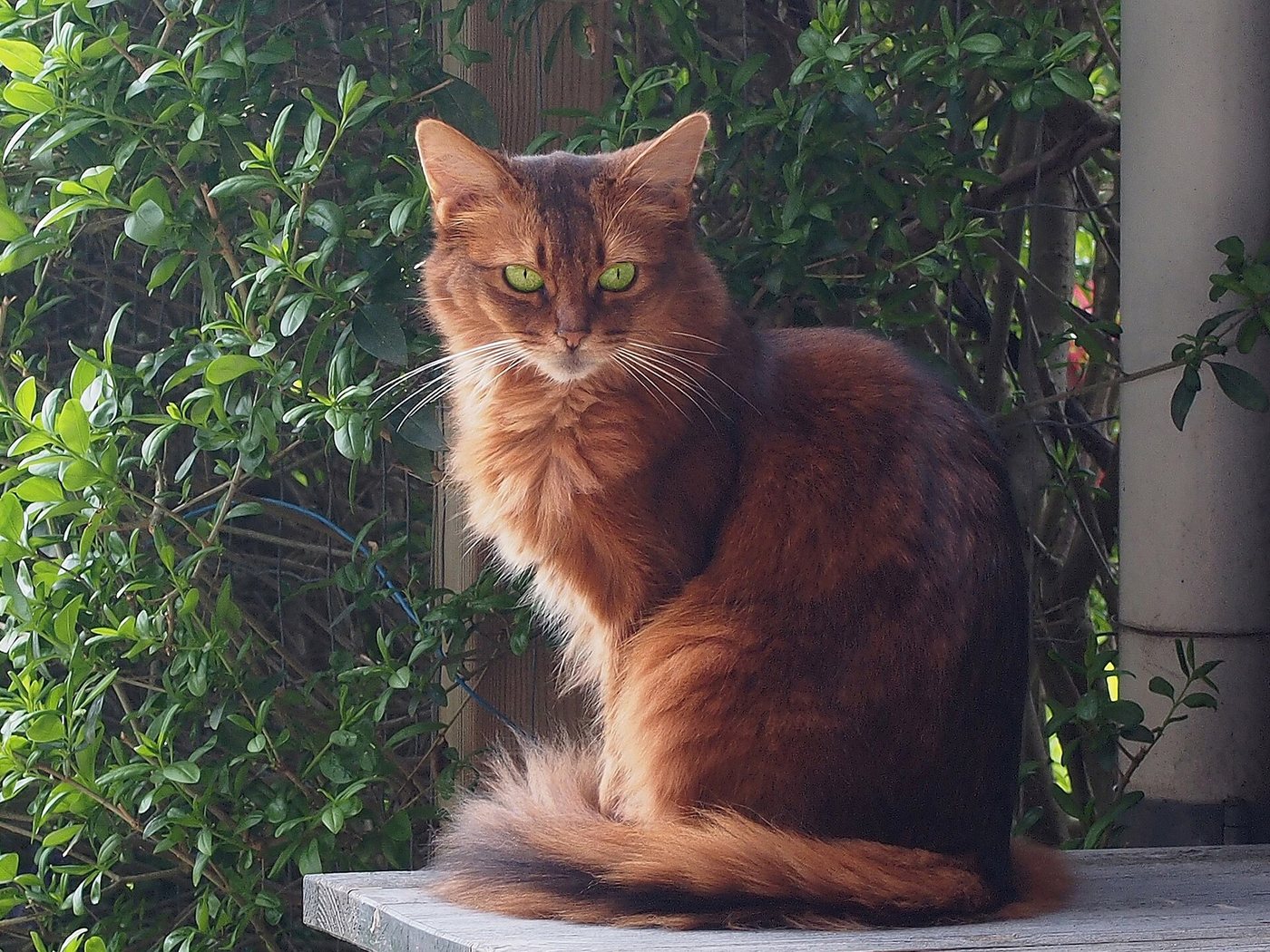
Overview
The Somali takes the Abyssinian's celebrated athleticism and clowning and wraps it in one of the most beautiful coats in the cat world — ticked, glowing, and fox-like, right down to the plumed tail. Everything the Aby is, the Somali is, with more theatre: the same door-opening, fetch-playing, water-investigating mischief in a more glamorous package. If you are choosing between the two, the Somali asks for a comb twice a week instead of once, and gives you a show cat's wardrobe in exchange.
Temperament & personality
Mischievous, athletic, and joyfully busy. Somalis play like kittens for most of their lives — fetching, leaping to the tops of doors, carrying toys, supervising every activity at high speed and higher altitude. They are intelligent and dexterous, famous for opening cupboards and turning on taps, and they adore their people without being clingy: a Somali wants to be in the same room, at the centre of the action, preferably above it. For all the energy, the voice is tiny — they communicate in soft chirps and, mostly, in deeds.
Appearance
The Somali is an Abyssinian dressed for autumn: a semi-long, silky coat in warm ticked colours — ruddy, sorrel (red), blue, and fawn — each hair banded with multiple stripes of colour, giving a glowing, agouti shimmer. The effect is fox-like, reinforced by a magnificent bushy tail, large cupped ears with tufts, dark 'mascara' lines around almond eyes, and a lithe, athletic body. This is one of the most glamorous coats in the cat world, yet it is soft and close-lying rather than puffy, and surprisingly resistant to matting for its length.
Care & daily life
The Somali's coat is easier than it looks — a comb-through once or twice a week keeps it gleaming, with a seasonal shed in spring. What Somalis truly demand is activity: they are athletes and comedians who need tall climbing furniture, interactive hunting games, and preferably a household that will laugh at their antics rather than a museum-quiet one. Pay particular attention to teeth — the Abyssinian family is prone to gingivitis and periodontal disease, so dental diets, brushing where tolerated, and regular vet dental checks are part of Somali ownership from a young age.
Health & lifespan
The Somali is generally known for the following health watch-points:
- Pyruvate kinase (PK) deficiency — an inherited red-blood-cell disorder shared with Abyssinians; a DNA test exists and breeders should screen
- Progressive retinal atrophy (rdAc PRA) — an inherited blinding condition of the Abyssinian family; DNA testing is available and standard in good programmes
- Periodontal disease and gingivitis are notably common in this family — dental care is a real, ongoing part of Somali ownership
- Patellar luxation occurs at modest rates; renal amyloidosis is historically associated with Abyssinian lines and is a fair question to raise with breeders
Living with a Somali
Somalis suit active households that want an involved, entertaining cat — homes with older children, other playful animals, and people who enjoy interaction over tranquillity. They are excellent for experienced owners and committed first-timers alike, as long as the home provides climbing, games, and company. They are indoor cats (that coat and that curiosity do not mix with traffic) and are not suited to owners who want a decorative, undemanding pet.
History
For decades, Abyssinian breeders quietly treated the occasional longhaired kitten as an embarrassment to be petted out and forgotten — the gene's origin is still debated, possibly introduced during the breed's bottleneck years when outcrosses were used to save it. In 1960s America, breeder Evelyn Mague instead saw beauty in them; her longhaired Abyssinian 'George' became a foundation cat, and she campaigned the variety into recognition — the CFA granted championship status in 1979. The name is a geographic joke: just as Somalia borders Ethiopia (ancient Abyssinia), the Somali borders the Abyssinian breed. The two remain one family, shown as separate breeds, sharing standards in everything but coat length.